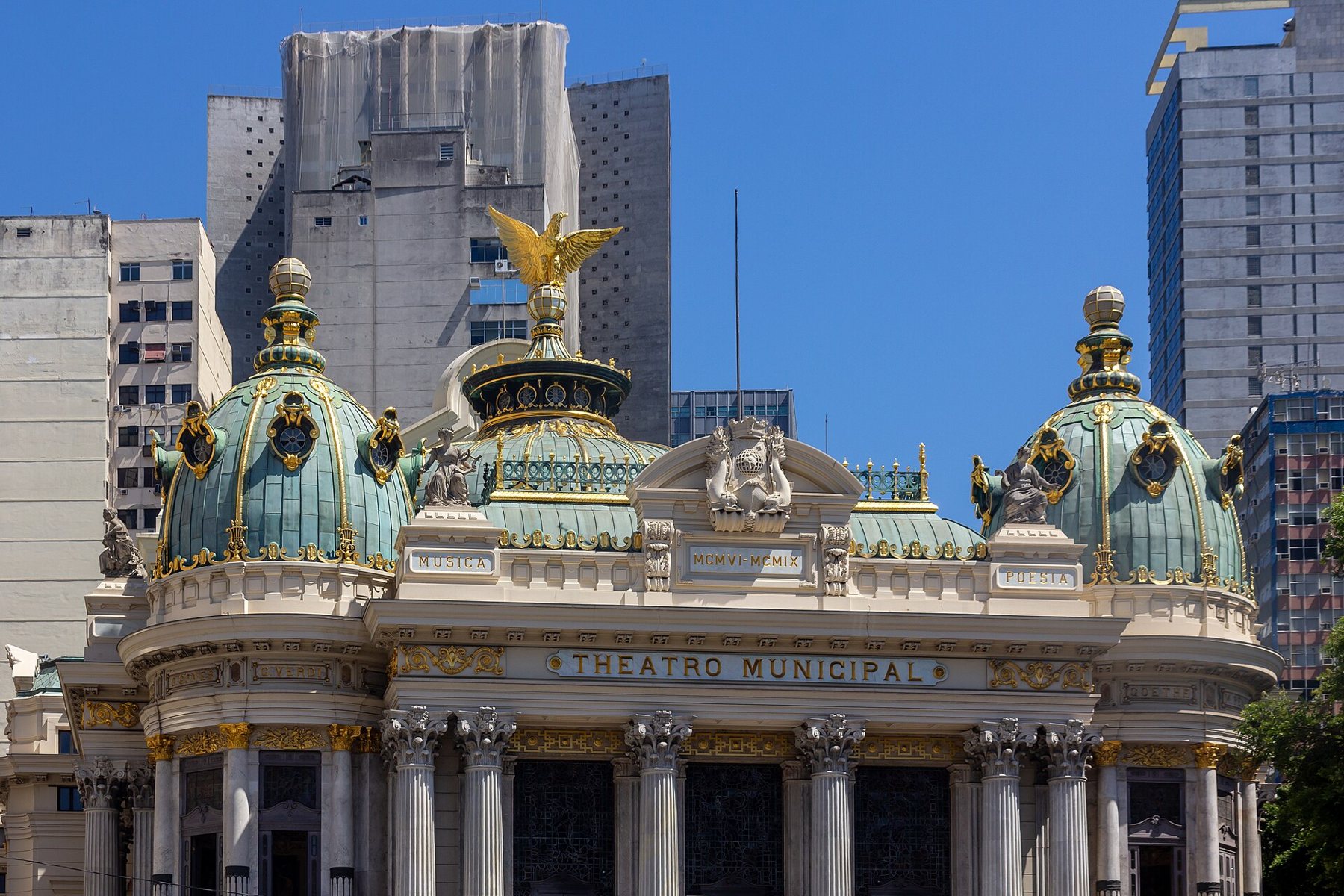
In the early twentieth century, Rio de Janeiro was the capital of Brazil and wanted to look like it. A grand new avenue was driven through the old colonial streets, and at its southern end, around a square, the city built a set of monumental buildings in the style of Paris: an opera house, a national library and a fine arts museum. The square later filled with cinemas, which gave the area the name it still carries, Cinelândia.
Most of the cinemas have gone, but the grand buildings remain, and together they make one of the most impressive short walks in the city.
Praça Floriano
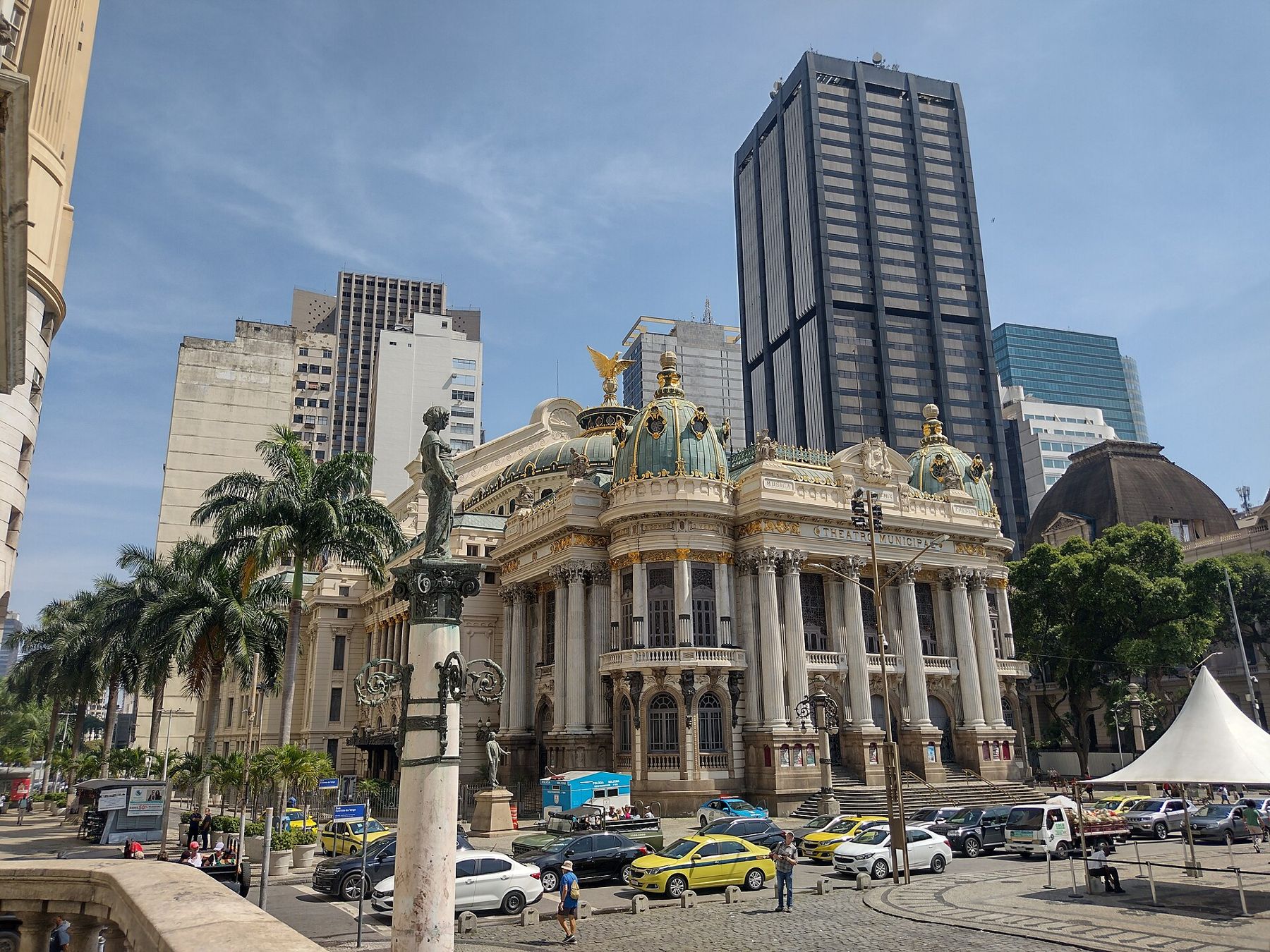
The walk starts at Praça Floriano, the square at the heart of Cinelândia, reached directly from the metro station of the same name. It is a busy, open place, with the city council building on one side and the three great buildings around it. Political rallies, protests and gatherings have often taken place here, and on a weekday the square is full of people crossing between offices.
The Theatro Municipal
The most striking building on the square is the Theatro Municipal, opened in 1909 and modelled on the Paris Opera. Its facade is a confection of columns, statues and a green and gold dome, and its interior is just as rich, with marble staircases, painted ceilings, stained glass and a horseshoe auditorium. It is still the city's main stage for opera, ballet and classical music.
Guided tours of the interior run on some days, and seeing a performance is the best way of all to experience it. Programmes and tour times change, so check before you go. Even from outside, at night when it is lit up, the building is a sight.
Look closely at the facade: the statues represent music, poetry and dance, and the names of composers are carved along the top. The building's interior includes a lavishly decorated restaurant hall in the basement, tiled in an Assyrian-inspired style, which is sometimes included on tours.
The library and the museum
Across the avenue stands the Biblioteca Nacional, the National Library of Brazil, one of the largest libraries in Latin America. Its collection grew from the royal library brought from Portugal by the court in the early nineteenth century. The building, completed in 1910, has a grand staircase and reading halls; guided visits run on some days.
Next to it, the Museu Nacional de Belas Artes, the national museum of fine arts, holds a large collection of Brazilian painting and sculpture from colonial times to the twentieth century, along with European works. It is a good place to see how Brazil saw itself through its artists. Check opening days; like many museums it closes on some weekdays.
Largo da Carioca
A short walk north brings you to Largo da Carioca, a busy square with a metro station and, rising above it on a small hill, the Convento de Santo Antônio, one of the oldest religious buildings in the city. A ramp leads up to its churchyard, a quiet refuge above the traffic. The station near here is also where the bonde to Santa Teresa begins its climb, crossing the arches of Lapa; see Santa Teresa: lanes, mansions and the bonde.
The Portuguese reading room
A few blocks further, on a narrow street near Praça Tiradentes, stands one of Rio's most surprising interiors. The Real Gabinete Português de Leitura, the Royal Portuguese Reading Room, occupies a carved stone building completed in 1887 in a Gothic-inspired style. Inside, a soaring hall is lined from floor to ceiling with dark wooden bookcases holding a vast collection of books in Portuguese, under a coloured glass skylight.
Visitors who come early often have the hall almost to themselves. Look up from the centre of the hall: the gallery levels, the iron railings and the glass ceiling draw the eye to the light, and the sheer number of books, rising tier above tier, is hard to take in at once. Visitors are usually welcome to look in during opening hours, quietly and without disturbing readers. It is a short visit but a remarkable one. Check the current opening times before you go.
The reading room was built by the Portuguese community of Rio, which was large and prosperous in the nineteenth century, as a library and a symbol of its cultural ties to Portugal. Its collection is one of the largest of Portuguese-language books outside Portugal, including rare early editions. The building's exterior, with its carved stonework, statues and Manueline-style decoration, is worth a long look in itself.
Bring a light layer for the reading room and the museums, whose air conditioning can feel cold after the heat of the street.
Putting the walk together
- Start at Praça Floriano and circle the theatre, library and museum.
- Walk north to Largo da Carioca and climb to the convent.
- Continue to the reading room near Praça Tiradentes.
- Finish by walking or taking the VLT towards Praça XV and the Paço Imperial.
All of it is flat, mostly on wide pavements, crossings and open squares, and within about 2.5 km, but with visits inside, it fills two or three hours comfortably. Go on a weekday, when buildings are open and streets busy. After dark, the area quietens, and it is better to take a taxi to and from evening performances. The arches and tiled steps of Lapa are a short walk to the south-west.